PREVIEW — feature in active design with Rutgers ARC. All charts use SYNTHETIC data for illustration only. Production launch target: Q3 2026.

From clinical companion
to clinical discovery.

A closed-loop research architecture for translational behavioral health AI — where clinician insight feeds canonical knowledge, and statistical rigor is a first-class citizen.

Every clinical AI platform today is a read-only dashboard. Knowledge gets created OUTSIDE the system and never feeds back IN. The Behavioral Cycle Research Platform inverts that — enabling clinicians and statisticians to author research queries, run them across cohorts, and promote vetted findings into the canonical library that drives every future patient interaction.

PTSD + SUD Cycle-phase aware HIPAA + IRB ready Python + R Jupyter Patent pending
Why it matters

Research, built into the platform.

Three commitments shape every design decision in the Research Platform.

01

Phase-conditioned insight

GUIDO already models the behavioral cycle. The Research Platform makes those phases first-class query primitives — so "which intervention works best in Build-Up" is a one-click analysis, not a three-week pivot table.

02

Closed-loop knowledge

When a finding is validated, it doesn't sit in a paper. It gets promoted into the LBM library and changes how GUIDO recommends interventions for every future patient. This is the Insight Feedback Loop — Patent Candidate S.

03

Statistical rigor by default

Multiple-testing correction, power analysis, reproducibility hashes, IRB scope enforcement — built into the query layer, not bolted on after. So research findings earn academic citation, not just clinician trust.

Sample analyses

What the platform surfaces.

Synthetic-data illustrations of the kinds of insight clinicians and statisticians can produce in minutes, not weeks. Each chart includes its own statistical annotation — p-values, effect sizes, sample sizes.
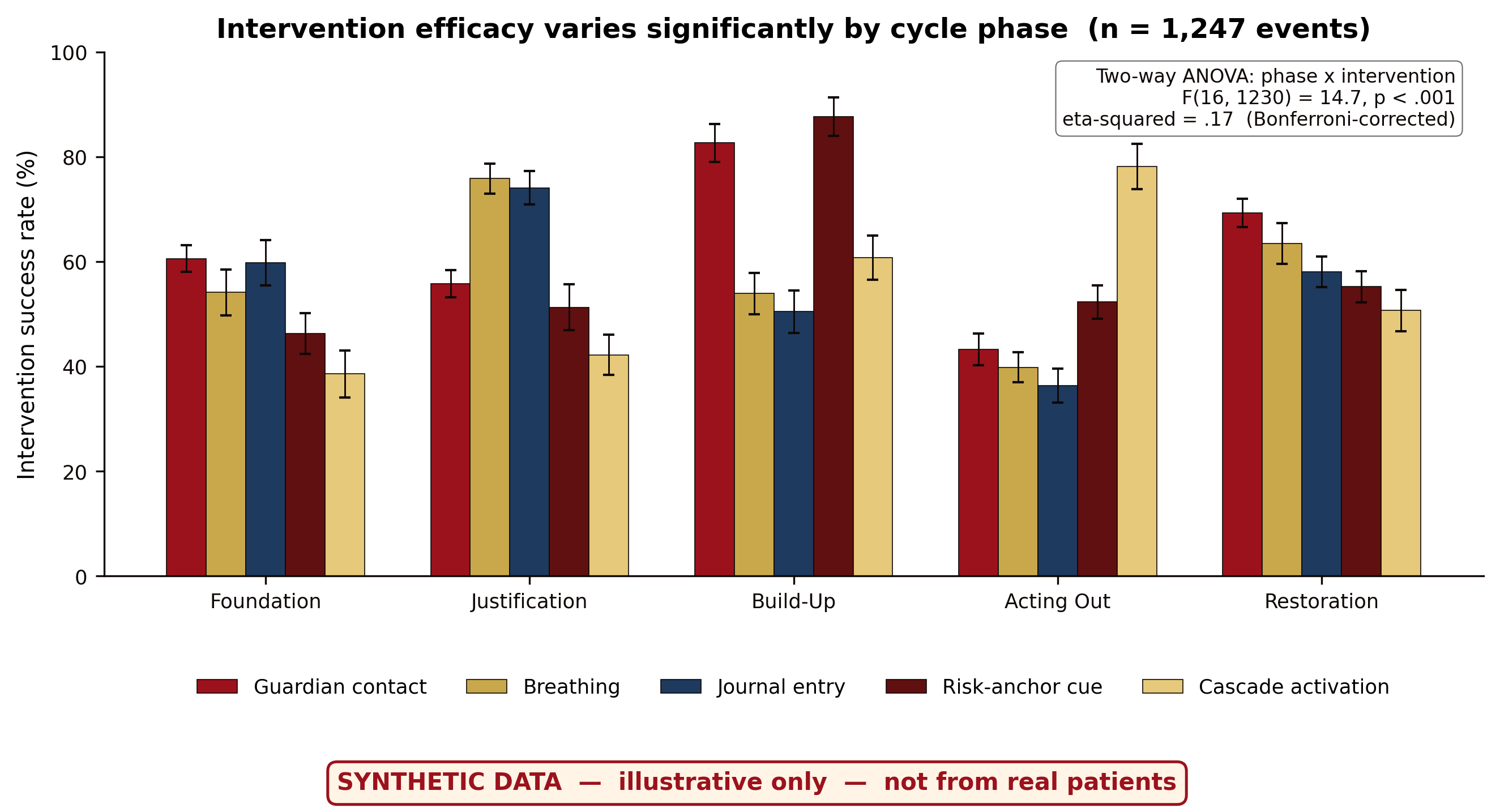
Intervention efficacy varies significantly by cycle phase
Intervention efficacy by cycle phase Two-way ANOVA reveals different interventions dominate at different phases. Guardian contact + Risk-anchor cue lead in Build-Up; Breathing + Journal lead in Justification.
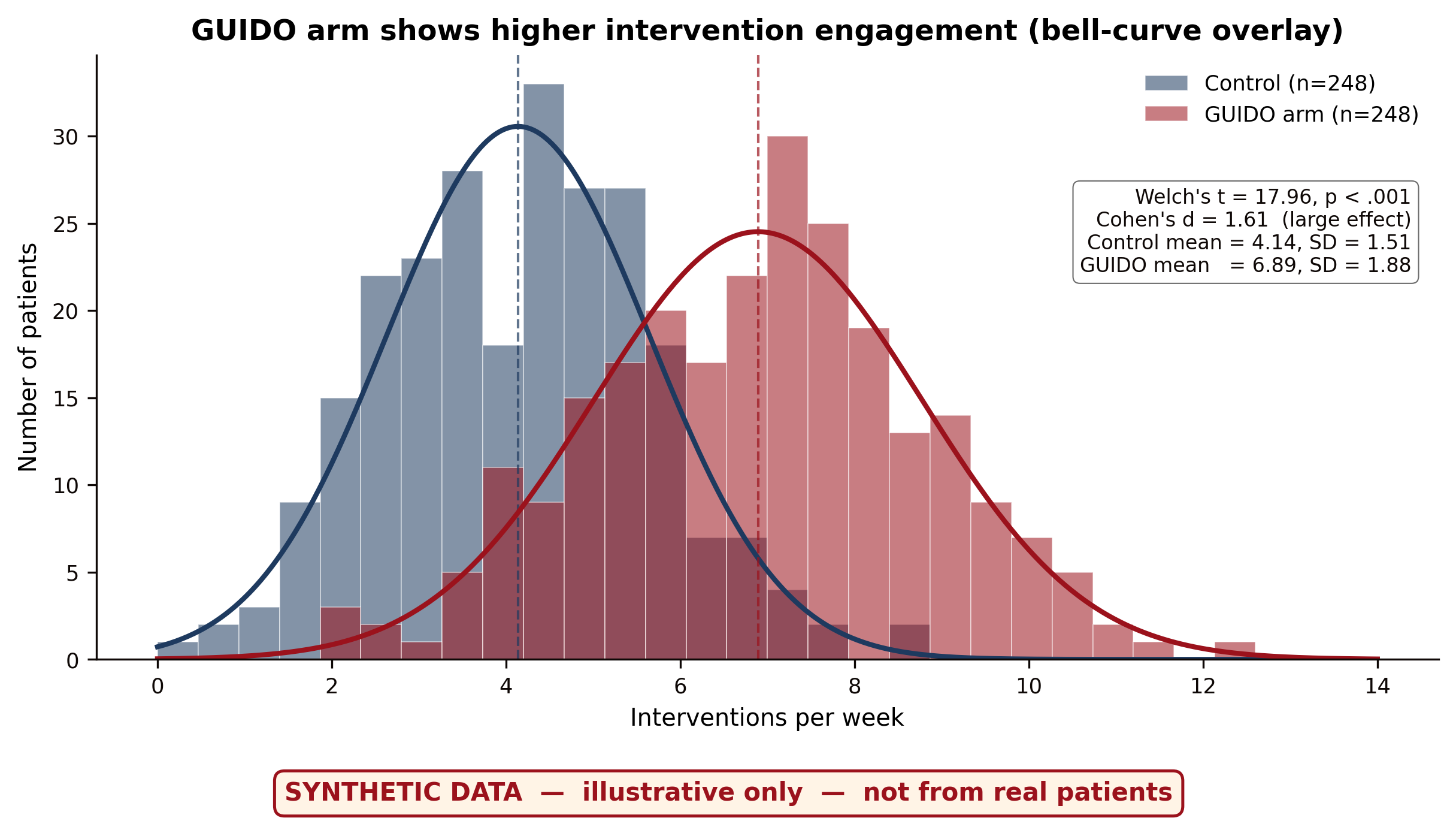
Bell-curve distribution comparing GUIDO arm vs Control
Bell-curve comparison: GUIDO vs Control Welch's t-test on weekly intervention engagement. Cohen's d = 1.61 (large effect). A measurable behavioral shift attributable to platform engagement.
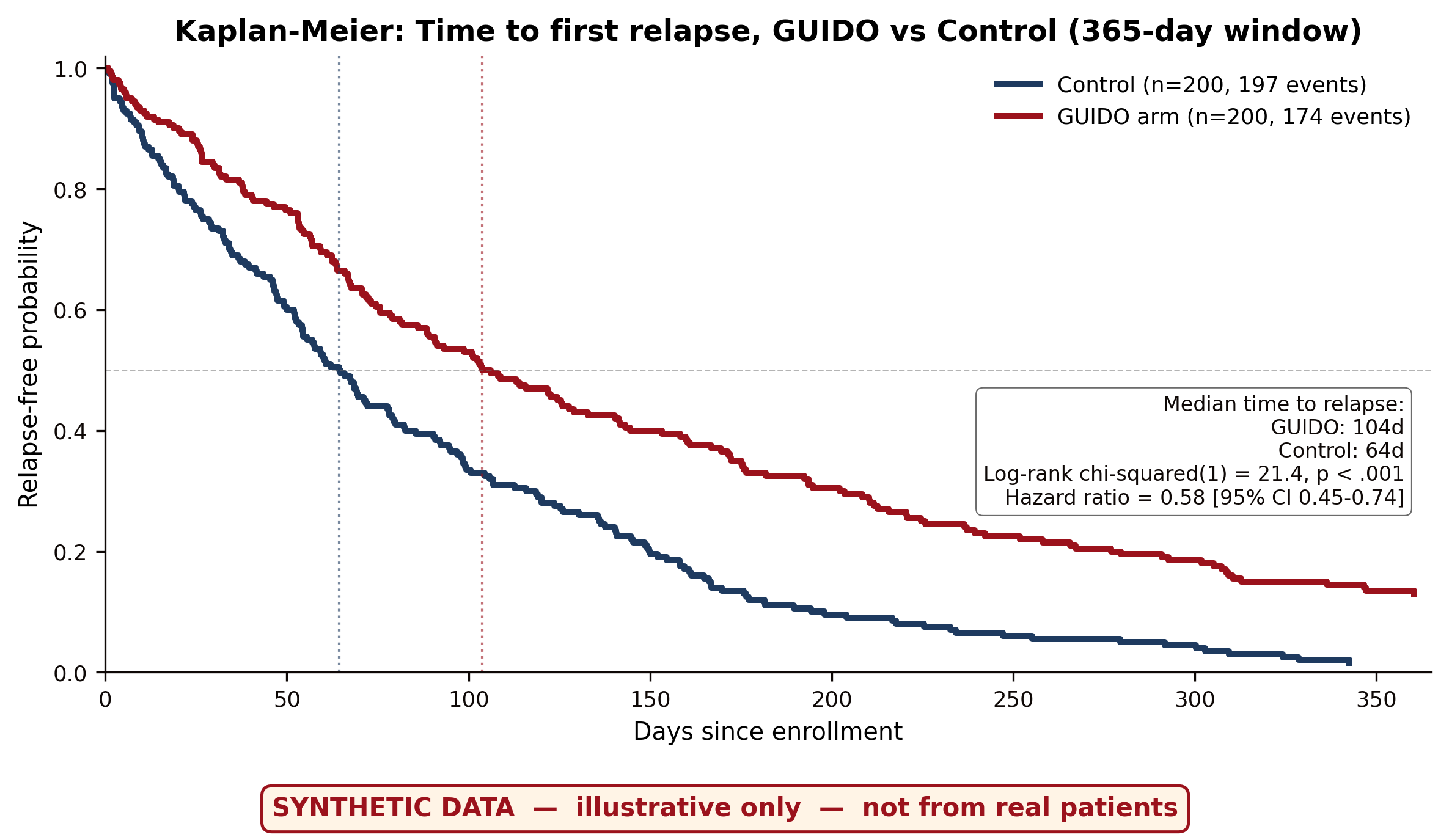
Kaplan-Meier survival curve, time to first relapse
Time-to-event: Kaplan-Meier survival GUIDO arm median 104 days to first relapse vs Control 64 days. Hazard ratio 0.58 [95% CI 0.45-0.74]. Log-rank p < .001.
Query authoring

What you can ask.

Sample queries from the clinician + statistician backlog. The platform answers them with cohort filters, phase-aware comparisons, and bring-your-own-statistical-method.

"Why does client X use more interventions per week than client Y?"
Individual cohort drill-down — patient-level engagement profile, comparison vs cohort norm.
"Which intervention works best when a patient is in Build-Up phase?"
Phase × intervention efficacy — the chart above. ANOVA + Bonferroni-corrected pairwise.
"Does family background predict Guardian Ring activation rate?"
Cross-tabulation + χ² test — categorical risk factor analysis. Cramér's V effect size reporting.
"What is the standard deviation of weekly engagement compared to the master LBM library?"
Distribution comparison + bell curve — cohort vs reference, with normal-overlay visualization.
"Does stress-reactivity moderate intervention efficacy across phases?"
Gene × Environment style interaction — interaction term test, effect heterogeneity analysis.
"Across 100 hypotheses, which findings survive multiple-testing correction?"
Bonferroni vs Benjamini-Hochberg FDR — automatic correction with discovery accounting.
Architecture

Four layers, each in service of the next.

The Research Platform is a layered architecture — each tier serves a different audience and builds on the one below it. The capstone is the Insight Feedback Loop.

L1

Ask GUIDO Research

Natural language query, AI-translated to cohort filter + statistical method. Returns table + chart + saved-template option.

For any clinician
L2

Cohort + Stats Palette

Drag-drop cohort builder + curated statistical primitives. Bell curves, t-tests, ANOVA, regression, multiple-testing correction.

For clinicians + statistician for 80% of questions
L3

Hosted Jupyter

Python + R notebooks via Vertex AI Workbench. HIPAA-eligible, sandboxed. R-primary for clinical statisticians; Python for ML methods.

For statistician + advanced clinicians
L4

Insight Feedback LoopiWhy gold?L4 is the capstone — the patent-pending closed-loop primitive that promotes vetted findings into the canonical LBM library. Gold ties it visually to the patent banner below. L1-L3 are the build steps; L4 is the strategic prize.

Vetted findings promote into the LBM library. Future GUIDO recommendations reflect the latest evidence. Patent Candidate S.

Closes the loop
For statisticians & research methodologists

Built for academic rigor.

Not a "data dashboard for clinicians." An academic-grade research infrastructure with the methodological commitments your reviewers will check for.

If you've spent your career running clinical research, here's what we built for you.

Every primitive below is exposed as a first-class function in the query layer — no need to drop into a notebook to apply the methodological controls academic publication demands.

Multiple-testing correction α
Bonferroni, Holm, Benjamini-Hochberg FDR. Family-wise error rate enforced by default on multi-hypothesis runs.
Power analysis a priori 1-β
Given cohort size + expected effect, see statistical power BEFORE running the analysis. Don't waste effort on underpowered tests.
G × E interaction primitives G×E
Phase × phenotype × intervention as a built-in 3-way interaction model. Cycle phase as moderator.
Reproducibility hashes π
Every saved query records the data snapshot it ran against. Re-run six months later and see exactly what changed.
Python + R Jupyter { }
Vertex AI Workbench, HIPAA-eligible. R-primary for statisticians (lme4, brms, ggplot2). Python for ML methods.
IRB scope enforcement §
Per-query IRB protocol ID required. Cross-protocol queries blocked. Audit ledger on every query. Compliance from day 1.

Patent Candidate S — Insight Feedback Loop

The closed-loop primitive — clinician-authored research query → IRB-vetted finding → promoted to canonical LBM library → influences every future patient recommendation. This is the defensible methodological innovation that turns the platform into a moat.

U.S. PROVISIONAL — filing planned post-VLA review
Roadmap

From spec to closed-loop, in four quarters.

Q3 2026

L1 ships

Ask GUIDO Research natural-language query layer. First clinician-authored queries.

Q4 2026

L2 ships

Cohort builder + curated statistical primitives. Most clinical questions answered in-platform.

Q1 2027

L3 ships

Hosted Jupyter (Python + R) via Vertex AI Workbench. Post-BAA. Statistician onboard.

Mid 2027

L4 shipsiWhy gold?This is the capstone milestone — when the Insight Feedback Loop ships, the platform's strategic moat (Patent Candidate S) is live. Gold marks the destination.

Insight Feedback Loop — IRB-vetted findings promote into the LBM library. Loop closed.

Building this with Rutgers ARC.

The Behavioral Cycle Research Platform is being designed in active collaboration with the Rutgers Addiction Research Center. If you are a clinical researcher, biostatistician, or funder interested in early access — we want to hear from you.